Decibel Chart: Common Sound Levels
A complete reference of everyday sounds and their approximate decibel levels. Use this chart to understand what your SnapRoomScore reading means in context.
What is a normal noise level?
A normal indoor noise level is typically between 30 and 50 decibels. 30 dB is a quiet bedroom at night, 40 dB is a quiet library, and 50 dB is typical home activity with appliances running.
dB Chart at a Glance
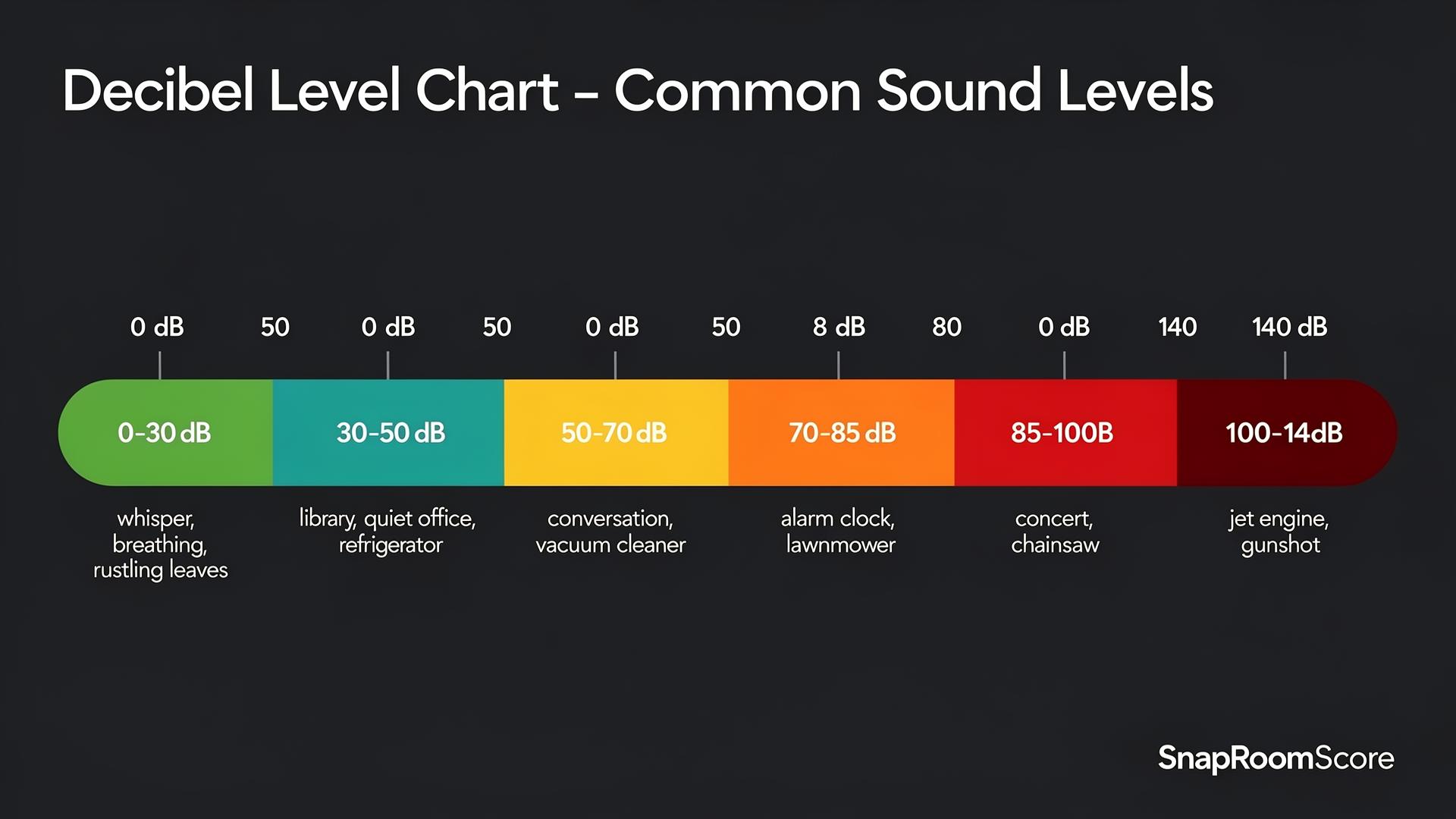
A quick sound chart of the six noise bands. Whether you call it a decibel chart, dB chart, noise chart or sound level comparison, these are the ranges that matter in everyday life.
0–30 dB
Ultra Quiet
Breathing, rustling leaves, a bedroom at night
30–50 dB
Calm
Library, refrigerator hum, light rain
50–65 dB
Moderate
Conversation, office buzz, dishwasher
65–85 dB
Distracting
Vacuum cleaner, busy restaurant, city traffic
85–110 dB
Loud
Lawnmower, chainsaw, rock concert
110 dB+
Hazardous
Jet engine, jackhammer, gunshot
Measure your own room and see which band it falls into — free, in your browser, in 3 seconds.
| dB Level | Sound Source |
|---|---|
| 10 | Normal breathing |
| 20 | Rustling leaves, quiet whisper |
| 30 | Quiet rural area at night |
| 40 | Quiet library, residential street |
| 50 | Moderate rainfall, refrigerator hum |
| 60 | Normal conversation, office buzz |
| 70 | Vacuum cleaner, busy restaurant |
| 80 | Heavy city traffic, alarm clock |
| 90 | Lawnmower, motorcycle at 8 m |
| 100 | Live rock concert, chainsaw |
| 110 | Power tools, riveting machine |
| 120 | Jet engine at 100 m, thunder |
| 130 | Jackhammer at 1 m, air raid siren |
| 140 | Gunshot, fireworks at close range |
| 150 | Jet engine at 25 m, firecracker |
| 160 | Shotgun blast, high-power rifle |
| 170 | Large firearms, safety airbag deployment |
What Each Level Means
Barely audible. The quietest sounds a healthy human ear can detect are around 0 dB; normal breathing sits at roughly 10 dB.
A whisper at arm's length. Sound studios target this range for background noise floors.
Ideal for deep sleep. The WHO recommends nighttime bedroom noise stays below 30 dB for uninterrupted rest.
Standard library ambience. Comfortable for concentration and study without fatigue.
Typical quiet home during the day. Research shows sustained levels above 50 dB begin to impair cognitive performance.
Everyday conversational speech measured at one metre. Most open-plan offices hover between 55 and 65 dB.
Noticeably loud. Prolonged exposure may cause stress and elevated heart rate, though hearing damage is unlikely at this level.
Beginning of the risk zone for long exposures. NIOSH recommends no more than 8 hours of continuous exposure at 85 dB.
Hearing protection advised if exposure lasts more than two hours. Equivalent to standing near a busy motorway.
Dangerously loud. NIOSH recommends a maximum unprotected exposure of 15 minutes at this level.
Pain threshold for some individuals. Extended exposure causes measurable hearing threshold shifts within minutes.
At the pain threshold. Sound pressure at this level is one trillion times the minimum audible level. Hearing damage can occur within seconds. A common 120 dB example is a car horn at 1 metre or an ambulance siren.
Physical discomfort in the ear canal. Any exposure without hearing protection risks immediate damage.
Instantaneous hearing damage. Even a single unprotected exposure can result in permanent noise-induced hearing loss.
Eardrum rupture becomes possible. This is the level of a fighter jet taking off nearby.
Permanent hearing damage on any exposure. Double hearing protection required for shooting sports.
170 decibels is the level of a .357 Magnum pistol or a car airbag firing 30 cm from the ear. Instant, severe, permanent hearing damage.
How the Decibel Scale Works
The decibel scale is logarithmic, not linear. This means that every increase of 10 dB represents a tenfold increase in sound intensity. A room at 50 dB is not "twice as loud" as one at 25 dB — it is roughly 300 times more intense in terms of sound intensity.
Human perception doesn't follow intensity linearly either. Psychoacoustic research shows that most people perceive a 10 dB increase as approximately "twice as loud." So a 70 dB vacuum cleaner sounds about twice as loud as a 60 dB conversation, even though the physical energy is ten times greater.
This non-linear relationship is precisely why decibel measurements matter for health. The jump from 80 dB to 90 dB may not seem dramatic subjectively, but it represents a tenfold increase in acoustic energy striking your eardrums and a significant reduction in safe exposure time — from 8 hours down to just 2 hours according to NIOSH guidelines.
Decibel Levels and Your Health
Noise-induced hearing loss is the second most common form of sensorineural hearing loss worldwide. Unlike age-related hearing decline, it is entirely preventable. The key thresholds to understand are:
- Below 70 dB — No risk of hearing damage regardless of duration. This is the safe zone for everyday environments.
- 70–85 dB — Extended exposure over many years may contribute to gradual hearing loss. Think of busy restaurants or city traffic.
- 85–100 dB — Active risk zone. The NIOSH recommended exposure limit drops from 8 hours at 85 dB to just 15 minutes at 100 dB.
- Above 100 dB — Immediate risk. Concert levels, power tools, and sporting events can cause measurable temporary threshold shifts after a single session.
Beyond hearing, chronic noise exposure above 55 dB is linked to elevated cortisol levels, increased cardiovascular risk, impaired cognitive performance in children, and disrupted sleep architecture. The European Environment Agency estimates that environmental noise contributes to 12,000 premature deaths annually across Europe.
How Long Is Each Decibel Level Safe? (NIOSH Exposure Times)
Every 3 dB increase doubles the sound energy — and halves the time you can safely be exposed without hearing protection.
| Noise level (dBA) | Maximum safe exposure |
|---|---|
| 85 dBA | 8 hours |
| 88 dBA | 4 hours |
| 91 dBA | 2 hours |
| 94 dBA | 1 hour |
| 97 dBA | 30 minutes |
| 100 dBA | 15 minutes |
| 103 dBA | 7.5 minutes |
| 106 dBA | 3.75 minutes |
| 109 dBA | under 2 minutes |
| 112–118 dBA | under 1 minute |
| 121–124 dBA | under 10 seconds |
| 130 dBA+ | no safe exposure |
Decibel Levels by Setting: Home, Work and Recreation
Most decibel charts stop at generic examples. These are the sounds you actually live with — grouped by where you meet them.
At home
- Refrigerator50 dB
- Washing machine50–75 dB
- Dishwasher55–70 dB
- TV at normal volume60–70 dB
- Vacuum cleaner60–85 dB
- Hair dryer60–95 dB
- Blender / food processor80–90 dB
- Baby crying at close range100–110 dB
At work
- Quiet office or library40 dB
- Open-plan office50–65 dB
- Power lawn mower65–95 dB
- Handsaw85 dB
- Subway platform90–115 dB
- Electric drill95 dB
- Factory machinery100 dB
- Jackhammer130 dB
Out and about
- Quiet residential street40 dB
- Freeway traffic70 dB
- Noisy restaurant85 dB
- Motorcycle95–110 dB
- Music club110 dB
- Rock concert110–120 dB
- Football stadium117 dB
- Fireworks at close range140–160 dB
How to Protect Your Hearing at Each Level
The simplest field test needs no equipment: if you have to raise your voice to be understood by someone an arm's length away, the environment is likely above 85 dB and the exposure clock has started.
- Turn it down. For sound you control — headphones, TV, car stereo — a 6 dB reduction quadruples your safe listening time.
- Add distance. Sound pressure drops roughly 6 dB every time you double your distance from the source. Standing 4 m from a speaker instead of 1 m is a 12 dB saving.
- Take quiet breaks. Exposure is cumulative across a day. Fifteen minutes at 100 dB uses your entire daily budget.
- Use protection above 85 dB. Foam plugs give 20–30 dB of attenuation; musician's filters give a flatter 15–20 dB that preserves clarity.
- Measure instead of guessing. Run a 30-second reading before assuming a room is fine — perception is unreliable above 70 dB.
How to Use This Chart with SnapRoomScore
Open SnapRoomScore and take a measurement. Compare your reading to the chart above to understand what common sounds produce similar levels. If your bedroom measures 42 dB, you're above the "quiet library" level and close to WHO's upper threshold for nighttime noise. If your office reads 65 dB, you're in the normal conversation range — but research suggests this impairs deep focus work.
Use the Trends page to track readings across multiple sessions. Cross-reference your averages with the chart to determine whether your environment falls within healthy ranges for your intended activity — whether that's sleeping, studying, recording audio, or simply relaxing.
For a deeper understanding of the science behind decibel measurements, visit our What Is a Decibel? educational guide, or explore acceptable noise levels for specific room types.
Looking for a specific sound? Our How Loud Is It? reference covers individual sources in detail — including a gunshot, a concert, a lawn mower, and a dishwasher — with safe exposure times for each.
Decibel Level Infographic
Decibel Chart FAQ
What is a normal noise level?+
A normal indoor noise level is typically between 30 and 50 decibels. 30 dB is a quiet bedroom at night, 40 dB is a quiet library, and 50 dB is typical home activity with appliances running.
How loud is 60 decibels?+
60 dB is roughly the volume of a normal conversation at arm's length. It is clearly audible but not uncomfortable for short periods.
At what decibel level does noise become dangerous?+
Sustained exposure above 85 dB can cause hearing damage. NIOSH recommends no more than 8 hours at 85 dB, with safe exposure time halving for every 3 dB increase.
What is the difference between dB and dBA?+
dBA applies A-weighting, which adjusts readings to match human hearing perception by de-emphasising very low and very high frequencies. Most noise regulations use dBA.
How long can I safely listen to 100 dB?+
About 15 minutes. NIOSH halves safe exposure time for every 3 dB increase above 85 dBA, so 100 dBA allows roughly 15 minutes per day without hearing protection.
Is 70 dB loud?+
70 dB is moderately loud — the level of freeway traffic or a vacuum cleaner. It will not damage hearing, but the EPA recommends staying below an average of 70 dBA over 24 hours.
How much louder is 10 dB?+
A 10 dB increase is ten times more sound intensity, and most people perceive it as roughly twice as loud. A 3 dB increase doubles the sound energy and halves your safe exposure time.
How can I measure decibels without a sound level meter?+
Use your phone's microphone. SnapRoomScore takes a 30-second reading in the browser, shows the dB level and converts it into a Room Quietness Score — no app or hardware needed.
Sources & Standards
- NIOSH — Criteria for a Recommended Standard: Occupational Noise Exposure (85 dBA / 8-hour limit, 3 dB exchange rate).
- OSHA — Occupational Noise Exposure standard 29 CFR 1910.95 (90 dBA / 8-hour permissible limit).
- WHO — Environmental Noise Guidelines for the European Region (under 30 dB in bedrooms at night).
- US EPA — Levels Document (below 70 dBA over 24 hours to prevent hearing loss).
- European Environment Agency — Environmental Noise in Europe (health burden of chronic noise).
Values on this page are typical ranges measured at normal listening distance; real levels vary with distance, room acoustics and equipment. See our measurement methodology for how SnapRoomScore calculates readings.
Measure Your Room Now
Related Indoor Noise Guides
Normal Noise Level in a Home
Room-by-room dB targets for bedroom, office, kitchen and living room.
How Quiet Should a Room Be?
Sleep, focus and recording thresholds explained.
Acceptable Noise Levels
WHO, OSHA and NIOSH standards in plain language.
Empty vs Furnished Rooms
Why furniture changes how loud a room feels.